
Subacromial pain syndrome
Also known as subacromial impingement
Pain on the outside of the shoulder that comes on when you lift your arm. This is the most common reason people with shoulder pain come to the clinic.
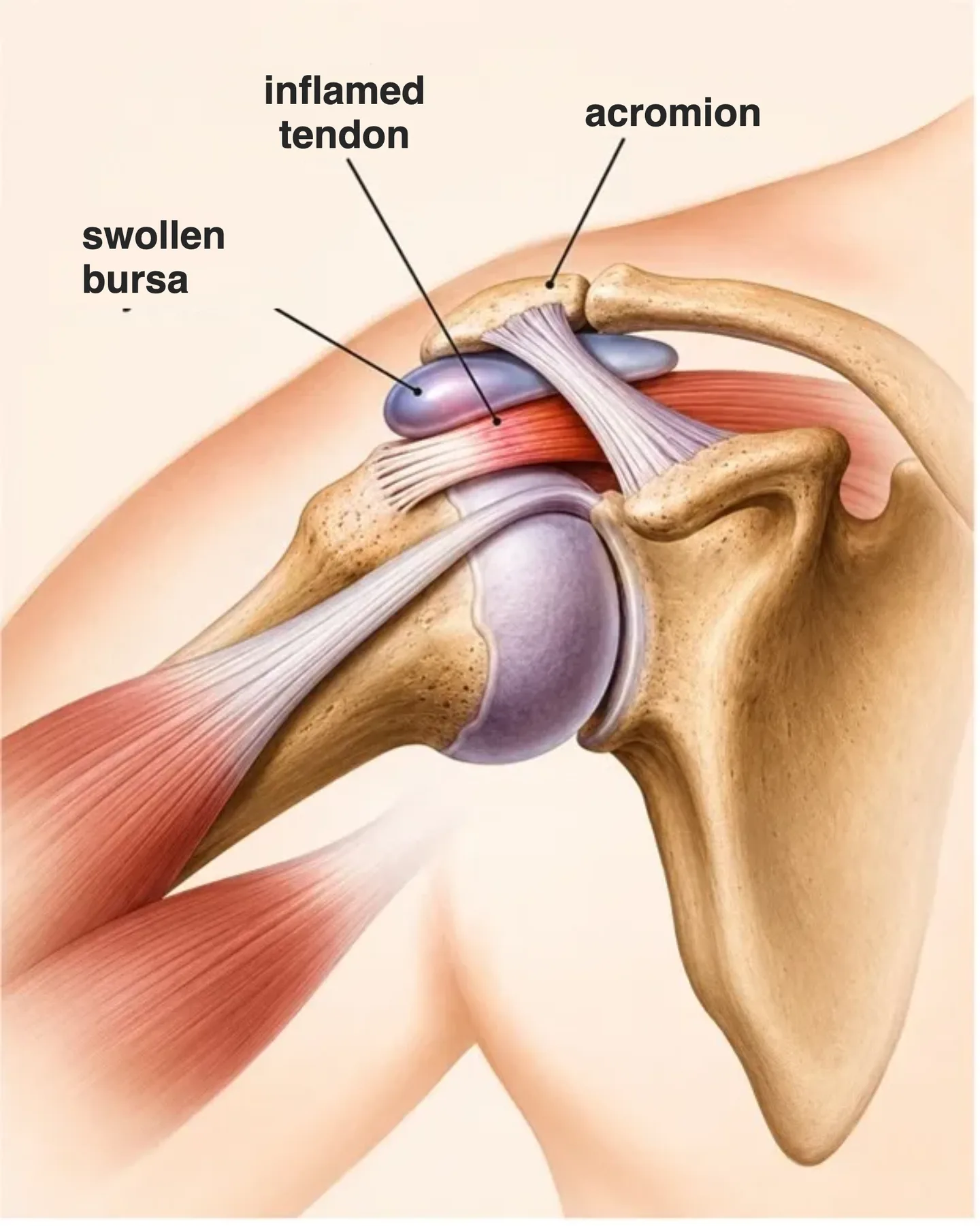
What is it?
Above the head of the shoulder sits a bony roof, the acromion. The rotator cuff tendons run underneath it, together with a bursa that keeps everything gliding smoothly. If that space becomes irritated or too tight, every movement above shoulder height hurts.
The symptoms usually build up gradually, often after a period of overhead work or sport. There is rarely one single moment you can point to.
Symptoms
- Pain on the outer and upper side of the shoulder, sometimes radiating into the upper arm
- Pain when lifting the arm, usually worst midway through the movement
- Pain at night, particularly when lying on the affected shoulder
- Difficulty with overhead tasks: washing your hair, filling a cupboard, putting on a coat
- Strength is usually preserved; it is mainly the pain that limits you
Examination
The conversation and the physical examination usually give the diagnosis. A number of targeted tests show us which structure is tender.
An X-ray rules out wear and calcium deposits. An ultrasound or MRI scan follows only if we suspect a tendon tear, or if the symptoms do not improve.
Treatment without surgery
Most people get better without surgery. Treatment comes down to three things: settling the irritation, adjusting the load for a while, and then teaching the shoulder to move well again.
- Physiotherapy aimed at posture, shoulder blade control and rotator cuff strength
- Temporarily less overhead loading, without immobilising the arm completely
- Painkillers or anti-inflammatory medication, for a short period
- Possibly an injection under the acromion, to make physiotherapy possible
Surgery
Surgery is rarely needed for SAPS. Well-structured physiotherapy, combined with a corticosteroid injection where needed, generally gives the same result as an operation. That is why it is always the first route.
Keyhole surgery is only considered for people who still have persistent symptoms after a good, sustained course of physiotherapy and therefore do not respond to conservative treatment. More often, the space under the acromion is freed up as part of an operation for another problem that occurs alongside it, such as a disorder of the biceps tendon or osteoarthritis of the AC joint, the small joint between the collarbone and the acromion.
The decision to operate is one we take together, based on how much it affects you and on what the earlier treatment achieved.
Recovery and rehabilitation
After keyhole surgery the arm may move straight away; a sling is only for comfort in the first few days. Physiotherapy starts quickly.
Most people resume light work after a few weeks. With heavy or overhead work it takes longer. Pain that stops waking you at night is often the first sign of improvement.
When to refer
For GPs and physiotherapists
Refer when pain does not improve sufficiently after six to twelve weeks of physiotherapy, when night pain disrupts sleep, or when there is doubt about an underlying tendon tear. Please send any imaging already performed.
Questions about your shoulder?
Discuss your symptoms at the consultation. You can see how to make an appointment per surgeon and per location.
View the consultationsFor detailed medical information per condition, we refer to our website Orthoca.
More information via Orthoca.beOpens in a new tabThis information is only available in Dutch.