
Rotator cuff tear
A tear of the rotator cuff, the tendon sleeve of the shoulder
A tear in one of the tendons that keep the shoulder stable and move it. Not every tear needs repairing: the best treatment depends on your symptoms, your age and how the tear came about.
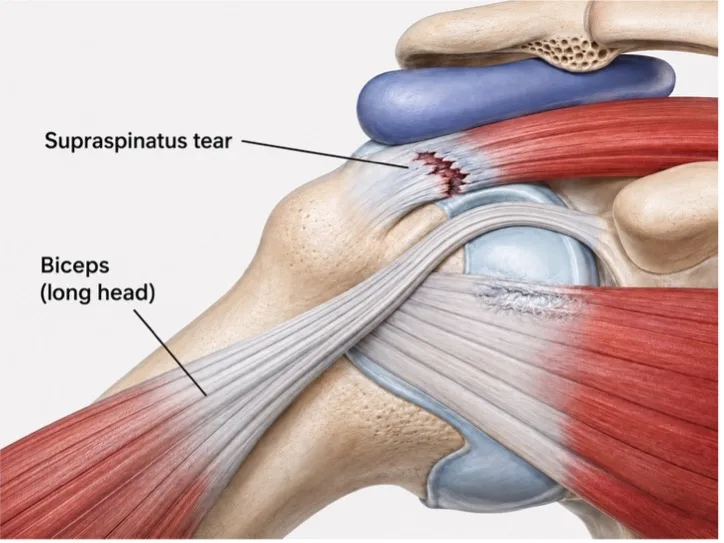
What is it?
The rotator cuff is a group of four tendons that hold the head of the shoulder in the socket and allow the arm to rotate and lift. A tear happens in one of two ways.
Through wear, the tendon frays gradually over years. That is common and does not always cause symptoms. In a fall or a sudden jerk, a healthy tendon can tear acutely; the symptoms are then usually obvious straight away.
Symptoms
- Pain on the outside of the upper arm, often hard to pinpoint
- Night pain, difficulty lying on the shoulder
- Loss of strength when lifting or outwardly rotating the arm
- The arm drops back down when you try to hold it out to the side
- With an acute tear: a clear moment, sometimes followed by bruising
Examination
The physical examination shows which tendon is affected and how much strength has been lost.
An ultrasound gives a quick answer for most tears. An MRI scan additionally shows the size of the tear, the quality of the muscle and whether the tendon can still be brought back. That is the information we need in order to plan a procedure.
Treatment without surgery
With a small tear, with little loss of strength, or in people who do not need to load the shoulder heavily, treatment without surgery often gives a good result. The surrounding muscles then take over part of the function.
- Physiotherapy aimed at the remaining cuff and at shoulder blade control
- Painkillers, and possibly an injection to make rehabilitation possible
- Adjusting overhead loading
Surgery
With an acute tear after an injury, with persistent loss of strength, or in a younger patient, we usually propose a repair. Through keyhole surgery we reattach the tendon to the bone with small anchors.
With a large, long-standing tear where the tendon can no longer be brought back, other solutions exist, such as a tendon transfer or a reverse shoulder replacement. What is possible in your situation is something we discuss at the consultation.
Recovery and rehabilitation
A repaired tendon needs time to heal onto the bone. You wear a sling for about six weeks; during that period the physiotherapist moves your arm for you.
After that you build up the movement yourself, and only later the strength. Full recovery takes four to six months, sometimes longer with heavy work. That long path is normal and is part of this procedure.
When to refer
For GPs and physiotherapists
Refer on acute loss of strength after a fall; time matters there. Also refer on persistent pain with loss of strength despite physiotherapy. Please send the ultrasound or MRI if one has already been performed.
Questions about your shoulder?
Discuss your symptoms at the consultation. You can see how to make an appointment per surgeon and per location.
View the consultationsFor detailed medical information per condition, we refer to our website Orthoca.
More information via Orthoca.beOpens in a new tabThis information is only available in Dutch.