
Shoulder instability
Dislocation and recurrent instability of the shoulder
The shoulder is the most mobile joint in the body, and for that reason also the joint that most easily comes out of its socket. After a first dislocation the chance of it happening again is real, certainly in young and sporty people.
What is it?
In instability the head of the shoulder comes fully or partly out of the socket. That often starts with a single dislocation, for example in a fall or a contact during sport. In the process the cartilage rim around the socket, the labrum, usually tears, and sometimes some bone is lost as well.
There is also a form without any accident, in people with naturally very supple joints. That calls for a different approach.
Symptoms
- A dislocation for which the shoulder had to be put back on the spot or in the emergency department
- The feeling that the shoulder is about to come out during certain movements
- Apprehension about moving the arm back and outwards, for example when throwing
- Repeated dislocations, which sometimes happen more and more easily
- Sometimes tingling or numbness in the arm just after a dislocation
Examination
During the examination we test in which direction the shoulder is unstable and how supple your joints are in general.
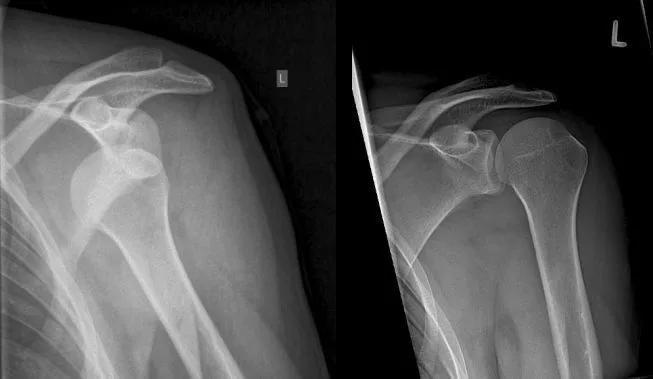
An X-ray shows bone loss at the socket or a dent in the humeral head. An MRI or CT scan maps the labrum and the amount of bone. Together with your age, your sport or work and the number of times the shoulder has dislocated, this determines which treatment suits you best.
Treatment without surgery
After a first dislocation there is a short period of rest in a sling, followed by physiotherapy. That focuses on the muscles that hold the head of the shoulder in the socket, and on control of the shoulder blade.
In instability without an accident, physiotherapy is almost always the first and often the only treatment.
Surgery
If the shoulder keeps dislocating, or the risk of that is high, we propose surgery. There are two main types of operation. In one, we reattach the torn labrum to the rim of the socket through keyhole surgery. In the other, the Latarjet procedure, we move a small piece of bone to the front of the socket so that the head is also held back mechanically.
Which operation suits you best is not only a matter of how much bone has been lost. Your age, your sport (especially contact sports), your work and the number of times the shoulder has already dislocated also count. In young people or contact athletes, for example, we sometimes opt for the Latarjet procedure even when bone loss is limited. We assess this case by case and discuss it with you.
Recovery and rehabilitation
After the operation you wear a sling for a few weeks. Physiotherapy follows, in which movement is released step by step.
Returning to contact or throwing sports usually takes four to six months, and only happens once strength and control have returned.
When to refer
For GPs and physiotherapists
Refer after a first dislocation in patients under 25 and in contact athletes, and refer anyone with a second dislocation. Please send the X-rays from before and after reduction.
Questions about your shoulder?
Discuss your symptoms at the consultation. You can see how to make an appointment per surgeon and per location.
View the consultationsFor detailed medical information per condition, we refer to our website Orthoca.
More information via Orthoca.beOpens in a new tabThis information is only available in Dutch.