
Proximal humerus fracture
Proximal humerus fracture
A fracture of the upper part of the upper arm, just below the shoulder, usually after a fall onto the arm or the shoulder. Most of these fractures heal without surgery.
What is it?
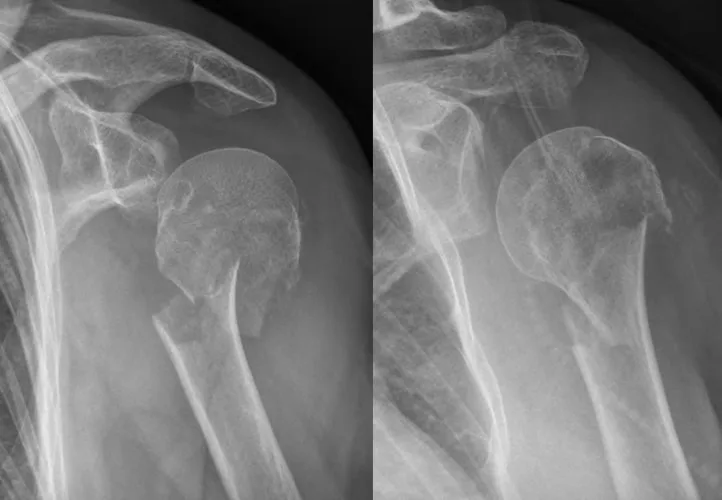
The proximal humerus is the upper section of the upper arm, where the head of the shoulder sits. A fall onto the outstretched arm or directly onto the shoulder can fracture that section.
In younger people the fracture is usually caused by a sports accident, a fall from height or a traffic accident. In older people a fall from standing height is often enough, especially when the bone is more brittle due to osteoporosis. Whether the fragments are displaced largely determines the treatment.
Symptoms
- Sudden, severe pain in the shoulder and upper arm after a fall
- Swelling, and after a few days extensive bruising extending down the arm
- Barely being able to move the arm, or not at all
- Holding the arm against the body to limit the pain
Examination
An X-ray confirms the fracture and shows how far the fragments have shifted.
For a fracture in several pieces we take a CT scan. That gives the exact position of each fragment and is needed in order to plan any surgery.
Treatment without surgery
The majority of these fractures are in a good enough position and heal without surgery. You wear a sling for a few weeks, and careful movement is started early.
Keeping still seems safer, but a shoulder that does not move for too long becomes stiff. Physiotherapy therefore follows a set schedule, with check X-rays to confirm that the position is holding.
Surgery
If the fragments are too far apart, or the head of the shoulder has tilted, surgery is indicated. For a fracture that can be reconstructed, we put the pieces back and fix them with a plate and screws, sometimes with pins.
With a shattered fracture, or in an older patient with fragile bone, repair is not always achievable. A reverse shoulder replacement is then often the most reliable solution.
Recovery and rehabilitation
With or without surgery, physiotherapy is the most important part of the treatment. In the first weeks the physiotherapist moves your arm for you, after which you build up yourself.
Recovery is slow: the pain settles within a few weeks, function and strength return over three to six months, sometimes longer. A small loss of movement sometimes remains.
When to refer
For GPs and physiotherapists
Where a fracture is suspected, the patient belongs in the emergency department or at an urgent consultation, with an X-ray. We are glad to see these patients quickly for the follow-up checks, including when the initial care took place elsewhere. In older patients an osteoporosis assessment is advisable.
Questions about your shoulder?
Discuss your symptoms at the consultation. You can see how to make an appointment per surgeon and per location.
View the consultationsFor detailed medical information per condition, we refer to our website Orthoca.
More information via Orthoca.beOpens in a new tabThis information is only available in Dutch.