
Frozen shoulder
Also known as adhesive capsulitis
A shoulder that first becomes painful and then stiff. An unpleasant but usually benign course: in most people the movement comes back on its own.
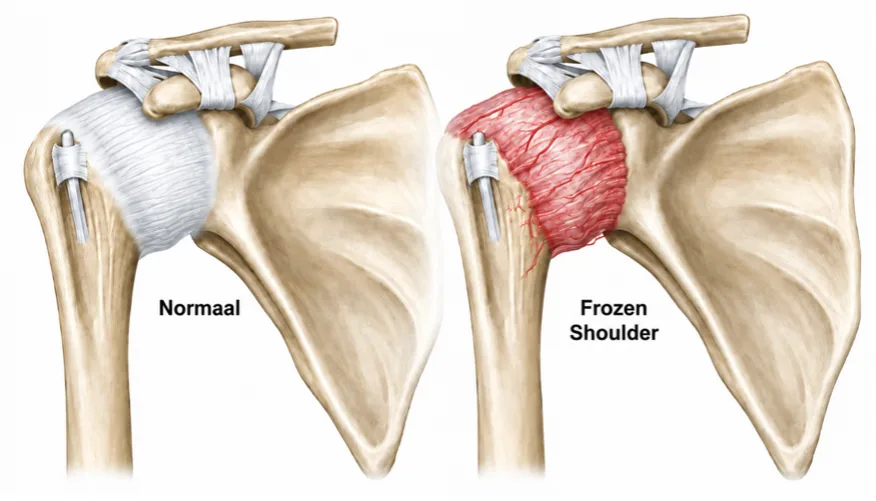
What is it?
The joint capsule around the shoulder becomes inflamed, thickens and contracts. That makes the shoulder not only painful but genuinely stiff: even when someone else moves your arm, it will not go further. That is what sets a frozen shoulder apart from most other shoulder problems.
Sometimes it starts for no identifiable reason, sometimes after an injury, an operation or a period of immobility. It is more common in people with diabetes or a thyroid condition, and usually occurs between the ages of 40 and 60.
Symptoms
A frozen shoulder runs through three phases that merge into one another. Together they usually last one to three years.
- Painful phase: increasing pain, especially at night, while movement slowly reduces
- Stiff phase: the pain settles, but the shoulder is clearly restricted in every direction
- Recovery phase: movement gradually returns

Examination
The physical examination is decisive. In a frozen shoulder it is mainly the outward rotation of the arm that is restricted, including when we move the arm passively.
We take an X-ray to rule out other causes of a stiff shoulder, such as arthritis. An MRI scan is usually not needed.
Treatment without surgery
Treatment is matched to the phase. In the painful phase the emphasis is on pain control, in the stiff phase on gradually regaining movement.
- A corticosteroid injection into the joint, particularly useful in the painful phase
- Physiotherapy: stretching within the limits of pain, without forcing
- Painkillers, including at night, so that you can sleep
Surgery
Surgery is rarely needed. If the shoulder stays stiff after a long period and that restricts daily life, we can release the contracted capsule through keyhole surgery, sometimes combined with carefully mobilising the shoulder under anaesthetic.
Recovery and rehabilitation
After a capsular release, intensive physiotherapy is needed straight away, in order to keep the movement that was gained.
Without surgery, patience is the main thing. Most people get their shoulder largely back, although a small restriction of movement can remain.
When to refer
For GPs and physiotherapists
Refer when the shoulder is also restricted passively, when night pain does not respond to painkillers, or when physiotherapy makes the symptoms worse. Please mention diabetes or thyroid disease where present.
Questions about your shoulder?
Discuss your symptoms at the consultation. You can see how to make an appointment per surgeon and per location.
View the consultationsFor detailed medical information per condition, we refer to our website Orthoca.
More information via Orthoca.beOpens in a new tabThis information is only available in Dutch.